

Why you should have an inhaler at home, which solutions are suitable for inhalations, and what steps to follow for maximum effect.
The essentials:
Inhalations for babies, just like for children and adults, are an effective and fast method for treating respiratory conditions.
What you should have in your home medicine cabinet so you can react promptly to difficulty breathing, and in which cases it’s appropriate to turn to inhalations.
How to do inhalations correctly – a step-by-step guide.
A sick baby is a nightmare for any parent – from the high fever, through difficulty feeding, breathing, and sleeping, to the simple fact that the baby can’t describe how they feel, and sometimes refuses medication, even fluids.
Parents look for ways to help their child recover faster, and often turn to inhalations.
For symptoms such as cough, runny nose, and difficulty breathing, inhalations provide fast relief and support quicker recovery. The good news is that they can be used from a very young age – even in infants. They act directly on the respiratory tract, applying the medication locally to the inflammation, without putting strain on the baby’s entire body. Inhalers (or nebulizers) turn a liquid solution into a fine mist that reaches directly into the lungs and improves breathing.
For which conditions are inhalations suitable? Which inhaler should you choose, and which solution? This article will answer all the important questions, so you’re prepared the next time your child is sick.
Why are inhalations suitable for babies?

Inhalations are an effective method for treating respiratory infections at any age, but especially in babies. They quickly relieve symptoms by delivering treatment directly to the respiratory tract, thinning secretions and making it easier for the body to clear them. In babies, this is a particularly important part of therapy, since their airways are much narrower, which makes them more prone to complications.
Inhalations done with saline solution are safe and can be used even in newborns. They moisturize the mucous membrane, reduce inflammation, and ease coughing. If a medication has also been prescribed as part of treatment, inhalation delivers it directly to the respiratory tract, and recovery is much faster.
When is it appropriate to do inhalations on a baby?
There are various conditions that require treatment with inhalations. Here are some of them.
Runny nose and blocked nose: Inhalations with saline solution help thin secretions and ease breathing.
Cough: They moisturize the respiratory tract and make expectoration easier.
Bronchiolitis and bronchitis: Inhalations can reduce inflammation and improve airway patency.
- Allergies: They help remove allergens from the nasal mucous membrane.
If the baby is under 6 months old, if you haven’t used inhalation therapy for treatment before, or if the baby has chronic conditions, you should always consult a pediatrician.
How to do the inhalation correctly?
Choosing an inhaler
In pharmacies and online, you’ll find various types of inhalers (nebulizers), and choosing can be difficult, even though it is essential for the effectiveness of inhalations for babies. There are several main types of inhalers:
Compressor inhaler: This type of inhaler uses compressed air to create an aerosol (the fine mist that reaches the respiratory tract). It is suitable for use with various medications and is effective for treating the lower respiratory tract.
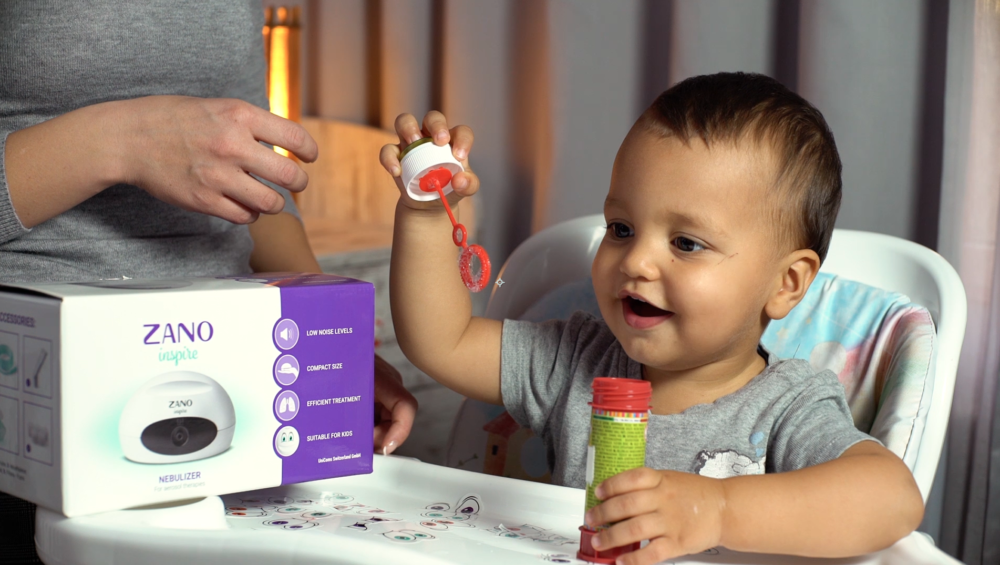
One of the downsides of compressor inhalers is that they tend to be quite noisy, due to the way they operate. For babies and young children, this matters especially, since the noise can frighten them. On the market, you’ll also find extremely quiet compressor nebulizers – one such example is Zano Inspire. It is effective for classic inhalations with saline solution, as well as for treatment with medications in more serious conditions. Zano Inspire is very quiet and very small, which doesn’t frighten children – quite the opposite, in fact – with it, and the special stickers you can decorate it with, you can turn inhalations into a game.
Ultrasonic inhaler: This type of inhaler uses ultrasonic waves to create an aerosol. It is more compact than a compressor inhaler, but is not suitable for all types of medications.
Mesh inhaler: This inhaler uses a vibrating membrane to create an aerosol. It is quiet, compact, and effective, but can be more expensive.
Choosing a solution
Saline solution (0.9% sodium chloride) is the most commonly used solution for inhalations in babies. It is safe, moisturizes the mucous membrane, and helps thin secretions. For more serious conditions, such as bronchiolitis, for example, the pediatrician may also prescribe medications to add to the solution, such as bronchodilators or corticosteroids, depending on the baby’s condition.
It is important to use only sterile solutions and to follow the pediatrician’s instructions regarding dosage and frequency of inhalations.
Inhalations step by step
Performing the inhalation correctly is essential for the effectiveness of the procedure. Follow these steps:
Preparing the inhaler: Make sure all parts of the inhaler are clean and dry. Assemble the device according to the instruction manual.
Adding the solution: Pour the recommended amount of saline solution or medication into the inhaler’s reservoir.
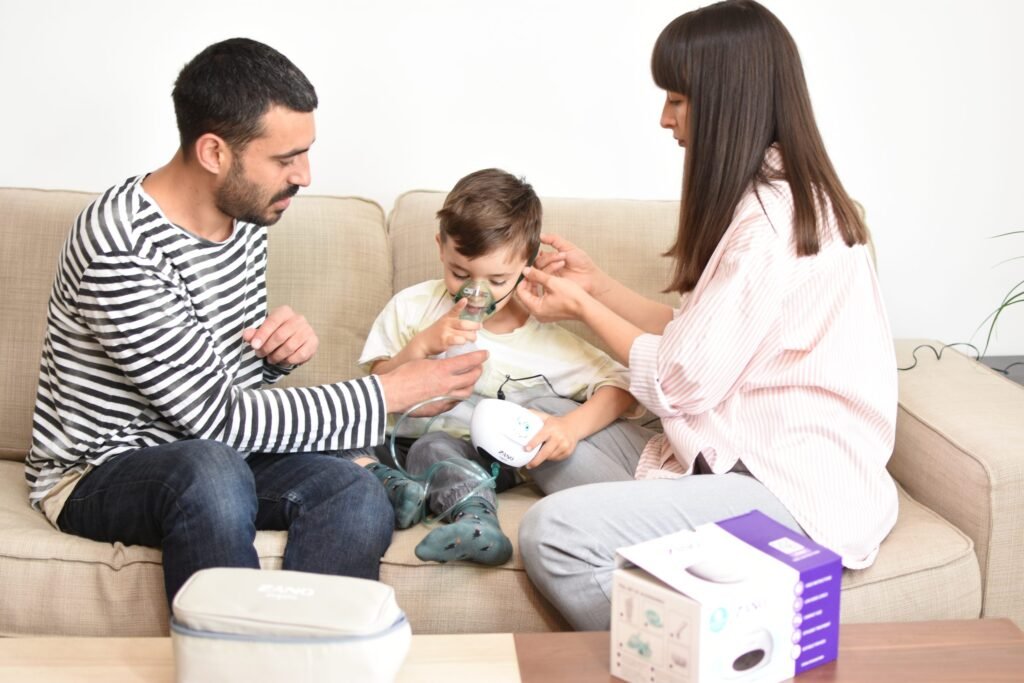
Placing the mask: Place it snugly over the baby’s face, covering the nose and mouth.
Positioning the baby: Hold the baby upright or slightly tilted back, to make breathing easier and allow for good penetration of the aerosol.
Performing the inhalation: Turn on the inhaler and let the baby breathe in the aerosol for about 5-10 minutes, or as recommended by the pediatrician.
After the procedure: Clean all parts of the inhaler and let them air dry. Wash the baby’s face to remove any residue from the solution.
It is important to perform inhalations while the baby is awake and calm. Avoid inhalations immediately after feeding, to prevent vomiting.
Conclusion
Inhalations are an effective and safe method for relieving symptoms of respiratory infections in babies. They help moisturize the mucous membrane, thin secretions, and ease breathing. It is important to consult a pediatrician regarding the medications used, and to strictly follow the steps of the procedure. With the right approach and good information, you’ll be able to quickly and easily take care of your sick baby and prevent complications.
Sources:
https://www.medicalnewstoday.com/articles/nebulizer-for-baby
https://www.cchwyo.org/news/2022/august/how-to-use-a-nebulizer-for-a-baby